BMI & weight
What Is a Healthy BMI? BMI Categories, Explained
A healthy BMI for most adults is 18.5 to 24.9. Here's what each BMI category means, how to work yours out, and when the number needs more context.
If you’ve ever typed your height and weight into a calculator and got back a single number like 23.4, you’ve probably wondered: is that good? Is it bad? Does it actually mean anything?
Short answer: for most adults, a healthy BMI is between 18.5 and 24.9. The longer answer is more useful, so let’s go through what BMI is, what each range means, and how to read your own number without overthinking it.
What BMI actually measures
BMI stands for body mass index. It’s a simple ratio of your weight to your height:
BMI = weight (kg) ÷ height (m)²
If you use pounds and inches, the formula is 703 × weight (lb) ÷ height (in)². You get the same answer either way.
That’s genuinely all it is. It doesn’t scan your body, measure fat or check your blood. It’s a quick screening number that doctors and public health researchers use because it’s cheap, fast, and on average it lines up reasonably well with body fat across large groups of people.
The BMI categories
These are the adult categories used by the World Health Organization, the CDC in the US and the NHS in the UK:
| BMI | Category |
|---|---|
| Below 18.5 | Underweight |
| 18.5 – 24.9 | Healthy weight |
| 25 – 29.9 | Overweight |
| 30 – 34.9 | Obesity (class 1) |
| 35 – 39.9 | Obesity (class 2) |
| 40 and above | Obesity (class 3) |
The “healthy” range is where, across big population studies, the risk of problems like type 2 diabetes, heart disease and high blood pressure tends to be lowest. As BMI climbs above 25, those risks gradually go up. Being underweight carries its own risks too, such as weaker bones, a less resilient immune system and nutrient gaps.
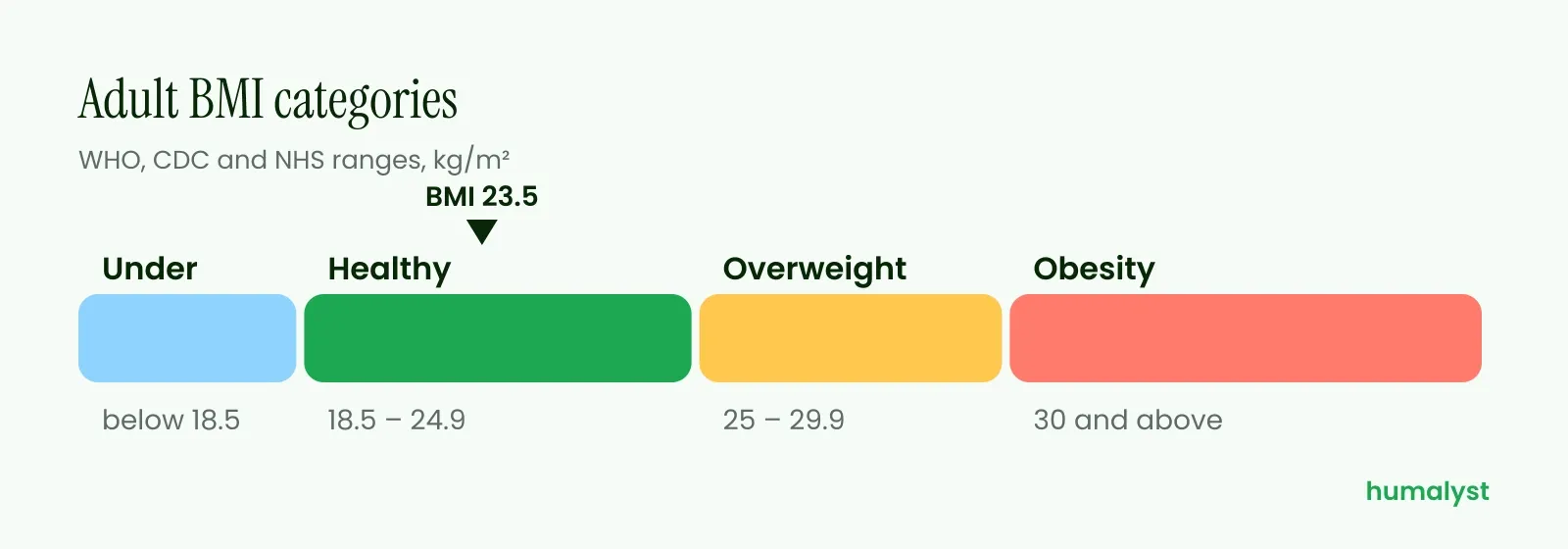
The adult BMI categories used by the WHO, CDC and NHS. A BMI of 23.5 sits comfortably in the healthy range.
A worked example
Say you’re 1.70 m tall (about 5’7”) and weigh 70 kg (about 154 lb).
- Square your height: 1.70 × 1.70 = 2.89
- Divide your weight by that: 70 ÷ 2.89 = 24.2
That’s in the healthy range, just under the line for overweight.
You can also flip the formula round to find your healthy weight range for your height. Multiply your squared height by 18.5 and by 24.9:
- 18.5 × 2.89 = 53.5 kg
- 24.9 × 2.89 = 72.0 kg
So at 1.70 m, a weight anywhere from about 53.5 to 72 kg falls in the healthy BMI range. That’s a wide window, nearly 19 kg, which is a helpful reminder that “healthy” isn’t one magic number.
Does the same range apply to everyone?
Not exactly, and this is where a lot of online calculators fall short.
Ethnicity. A WHO expert panel found that for many Asian populations, health risks start rising at a lower BMI than for white European populations. Because of that, health services such as the NHS suggest people of South Asian, Chinese, other Asian, Middle Eastern, Black African or African-Caribbean background treat a BMI of 23 as the point where risk starts to rise, and 27.5 as the threshold for obesity.
Children and teenagers. BMI works differently for under-18s. It’s compared against growth charts for age and sex, so adult categories don’t apply.
Pregnancy. BMI isn’t used to judge weight during pregnancy. Your midwife or doctor will use different guidance.
Older adults. Some research suggests a slightly higher BMI may not carry the same risks later in life. It’s worth discussing with a GP rather than chasing a lower number on your own.
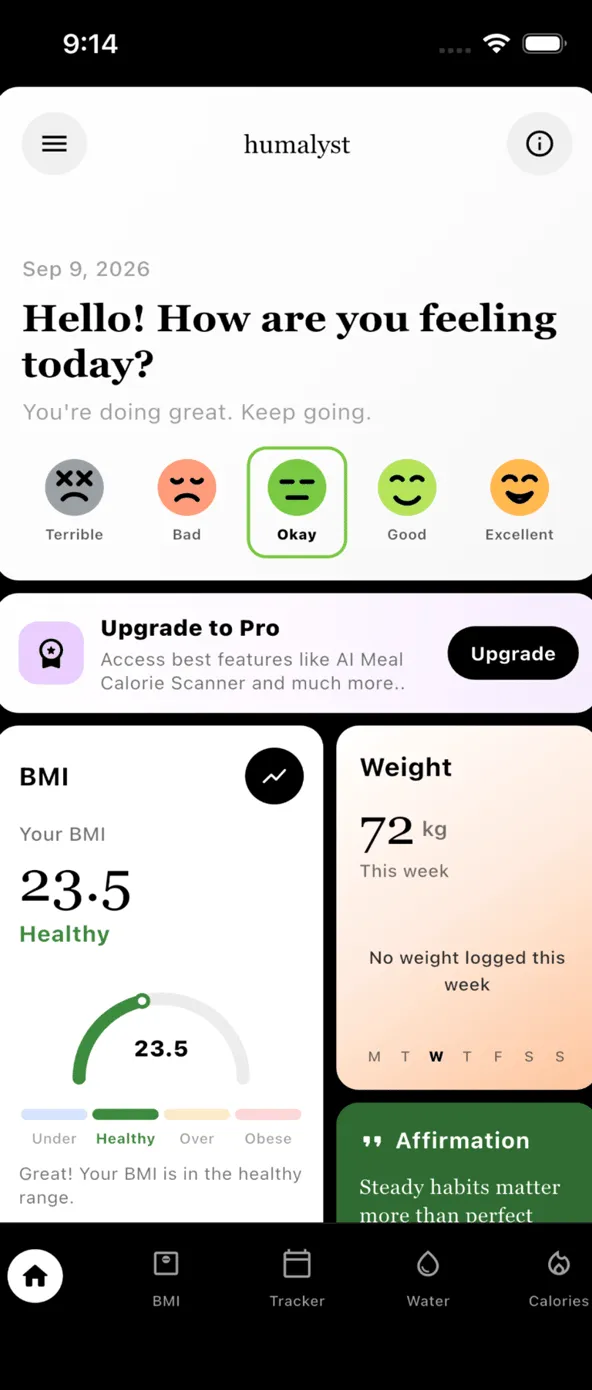
Humalyst shows your BMI, category and healthy range on the home screen.
What to do with your number
Think of BMI as a starting point for a conversation, not a verdict.
- If you’re in the healthy range, great. Keep doing what’s working: regular movement, decent sleep, mostly whole foods. Re-check every few months.
- If you’re slightly above 25, don’t panic. Look at your waist measurement too (we explain why in Is BMI accurate?). Small, steady changes usually beat dramatic ones.
- If you’re 30 or above, or below 18.5, it’s worth a chat with your doctor. Not because something’s necessarily wrong, but because they can look at the whole picture: blood pressure, blood tests, family history.
If weight loss is your goal, our guide on how many calories you need to lose weight walks through the maths without the crash-diet nonsense.
The bottom line
A healthy BMI for most adults is 18.5 to 24.9. It’s a useful, quick check, but it’s one number among several. Pair it with your waist size, how you feel and how active you are, and you’ll have a much more honest read on your health than any single figure can give you.
Quick answers
What is a healthy BMI for an adult?
For most adults, a BMI between 18.5 and 24.9 is considered a healthy weight. Below 18.5 is underweight, 25 to 29.9 is overweight and 30 or above is obesity.
Is a BMI of 25 bad?
A BMI of 25 sits right on the line between healthy and overweight. On its own it isn't a diagnosis. Your waist size, activity level and family history give a much fuller picture.
Is the healthy BMI range the same for everyone?
Not quite. Health bodies in several countries use lower thresholds for people of South Asian, Chinese and some other ethnic backgrounds, because health risks tend to rise at a lower BMI. BMI also isn't used the same way for children or during pregnancy.
Sources
This article is general information, not medical advice. If you have a health condition, are pregnant, or are making a big change to how you eat or drink, talk to a doctor or registered dietitian first.
Keep reading
 BMI & weightIs BMI Accurate? What It Gets Right (and Wrong)BMI is a useful screening tool, but it can't tell muscle from fat. Here's when it's reliable, when it isn't, and two simple checks that add real context.
 NutritionHow Many Calories Should I Eat to Lose Weight?Work out your maintenance calories, pick a safe deficit and see what that means in real numbers. A step-by-step guide without the crash-diet nonsense.
 Habits & moodHow to Build Healthy Habits That Actually StickForget the 21-day myth. Here's what research says about how long habits take to form, and six practical ways to make healthy habits stick for good.