BMI & weight
Is BMI Accurate? What It Gets Right (and Wrong)
BMI is a useful screening tool, but it can't tell muscle from fat. Here's when it's reliable, when it isn't, and two simple checks that add real context.

BMI gets a lot of criticism. You’ve probably heard someone say “BMI is useless, it says The Rock is obese.” And there’s a grain of truth in that. But calling it useless isn’t fair either.
So is BMI accurate? It’s a decent screening tool for most people, and a poor one for some. The trick is knowing which group you’re in, and adding one or two easy checks to fill the gaps.
What BMI gets right
BMI was designed to study populations, not to diagnose individuals. At that job, it does pretty well. Across large groups of people, a higher BMI tracks with a higher risk of type 2 diabetes, heart disease, high blood pressure and some cancers.
It’s also fast and free and needs nothing more than a tape measure and a scale. That’s why doctors still use it as a first check. The CDC describes it plainly as a screening measure. It flags who might need a closer look, and that’s all it’s meant to do.
Where BMI falls short
1. It can’t tell muscle from fat
BMI only knows your total weight. A kilo of muscle and a kilo of fat count exactly the same.
Take someone who’s 1.80 m tall and weighs 95 kg. Their BMI is 29.3, which is close to the obesity line. If that person plays rugby and trains five days a week, most of that weight could be muscle. Their actual health risk may be low.
The reverse happens too. Someone can have a “healthy” BMI but carry very little muscle and a fair amount of fat. That’s sometimes called “normal-weight obesity”, and BMI misses it completely.
2. It ignores where fat sits
Fat stored around your belly, especially the deeper fat around your organs, is more strongly linked to health problems than fat on your hips or thighs. Two people with the same BMI can have very different risk profiles because of this.
3. One size doesn’t fit everyone
Health risks start rising at a lower BMI for many people of Asian background, and for some other ethnic groups. Body composition also shifts with age. We tend to lose muscle as we get older, so the same BMI can mean more body fat at 70 than at 30. Sex matters as well: at the same BMI, women typically carry more body fat than men.
In 2023 the American Medical Association adopted a policy saying BMI shouldn’t be used on its own in clinical care, partly because of these exact issues.
Two simple checks that add context
You don’t need a lab. Grab a tape measure.
Waist circumference
Measure around your middle, roughly halfway between your lowest rib and the top of your hip bone. Breathe out normally, and don’t suck in.
The NHS says your risk of health problems is higher if your waist is:
- 94 cm (37 in) or more for men
- 80 cm (31.5 in) or more for women
Waist-to-height ratio
This one is even simpler and works for most adults regardless of sex or ethnicity:
Keep your waist to less than half your height.
So if you’re 170 cm tall, aim for a waist under 85 cm. A ratio of 0.5 or higher suggests more fat around the middle than is ideal.
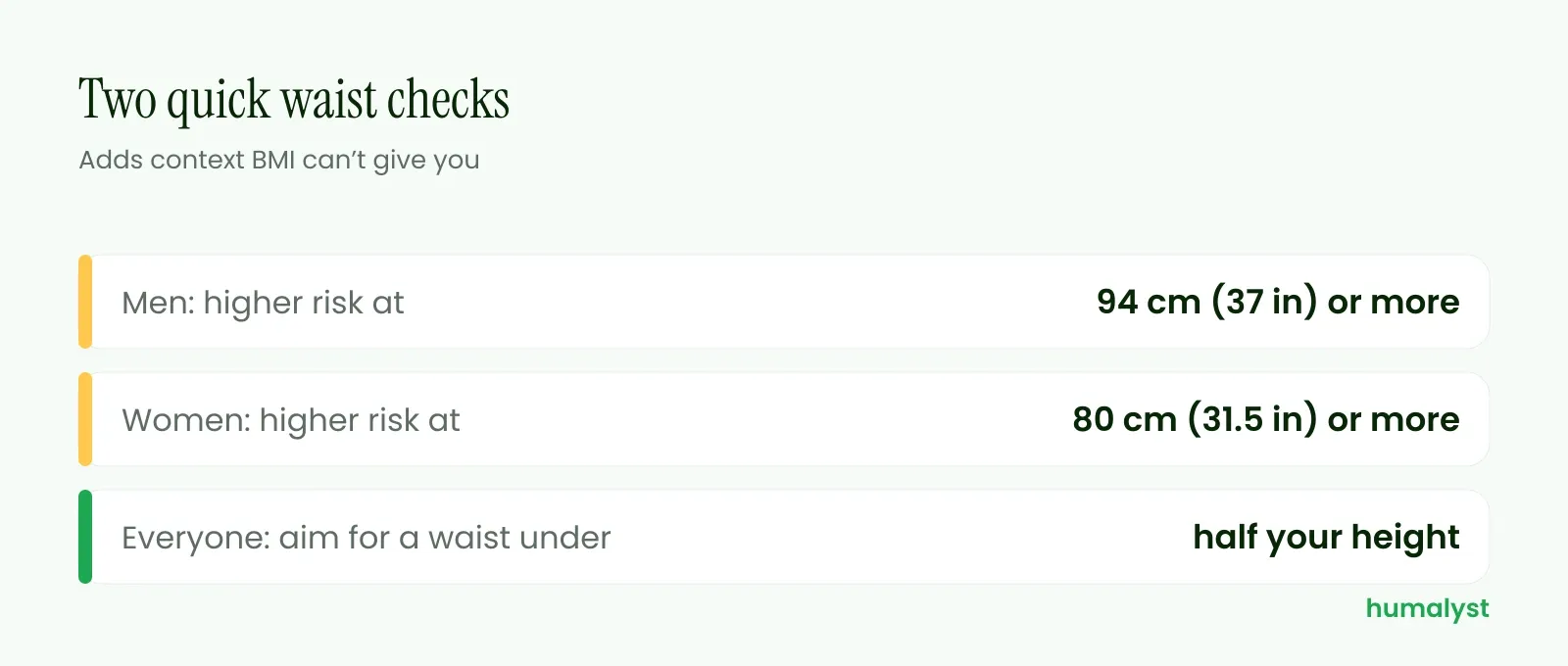
Two quick waist checks that add the context BMI can’t give you.
So, should you bother with BMI at all?
Yes, just don’t use it alone. Here’s a sensible way to read it:
- BMI in the healthy range and waist under half your height: you’re probably in good shape.
- BMI over 25 but small waist and you’re very active: likely muscle. Keep an eye on it, but don’t stress.
- BMI in the healthy range but waist creeping up: worth paying attention to. It can be an early sign of fat building around your middle.
- BMI over 30 and a larger waist: a good time to talk to your GP about the bigger picture.
If you’re not sure what your BMI number means yet, start with our guide to what counts as a healthy BMI. And if you’re trying to build muscle rather than just lose weight, how much protein you need per day is the next thing to read.
The bottom line
BMI is accurate enough to be useful and flawed enough to mislead if you lean on it too hard. Treat it as one clue, add your waist measurement, and remember that how you feel, how you move and what your doctor sees all count for more than any single number.
Quick answers
Is BMI accurate for muscular people?
Often not. BMI can't tell muscle from fat, so people with a lot of muscle, like many athletes, can land in the overweight or even obese range while having low body fat.
What is a better measure than BMI?
No single measure is perfect, but waist circumference and waist-to-height ratio are easy to do at home and add useful information about fat around your middle, which is linked to health risk.
What waist size is healthy?
A simple rule used by UK health guidance is to keep your waist to less than half your height. The NHS also flags higher risk at 94 cm (37 in) or more for men and 80 cm (31.5 in) or more for women.
Sources
This article is general information, not medical advice. If you have a health condition, are pregnant, or are making a big change to how you eat or drink, talk to a doctor or registered dietitian first.
Keep reading
 BMI & weightWhat Is a Healthy BMI? BMI Categories, ExplainedA healthy BMI for most adults is 18.5 to 24.9. Here's what each BMI category means, how to work yours out, and when the number needs more context.
 NutritionHow Much Protein Do You Need Per Day?The 0.8 g/kg rule is a minimum, not a target. Here's how much protein you need per day by weight, age and goal, plus what that looks like on a plate.
 NutritionHow Many Calories Should I Eat to Lose Weight?Work out your maintenance calories, pick a safe deficit and see what that means in real numbers. A step-by-step guide without the crash-diet nonsense.