Nutrition
How Many Calories Should I Eat to Lose Weight?
Work out your maintenance calories, pick a safe deficit and see what that means in real numbers. A step-by-step guide without the crash-diet nonsense.

There’s no universal number. Anyone who tells you “eat 1,200 calories and you’ll lose weight” without asking a single question about you is guessing.
The good news is that working out your number isn’t hard. It’s three steps: find your maintenance calories, take off a sensible amount, and check your progress after a few weeks.
Step 1: Work out your maintenance calories
Your maintenance calories are what you’d eat to stay the same weight. They’re made of two parts:
- Your BMR (basal metabolic rate): what your body burns just keeping you alive (breathing, circulation, keeping warm).
- Your activity: everything else, from walking to the kettle to a gym session.
The most widely used way to estimate BMR is the Mifflin–St Jeor equation. It’s the one most dietitians reach for, and it’s what Humalyst uses:
Men: (10 × weight in kg) + (6.25 × height in cm) − (5 × age) + 5
Women: (10 × weight in kg) + (6.25 × height in cm) − (5 × age) − 161
Then multiply by an activity factor:
| Activity level | Multiplier |
|---|---|
| Mostly sitting, little exercise | 1.2 |
| Light exercise 1–3 days a week | 1.375 |
| Moderate exercise 3–5 days a week | 1.55 |
| Hard exercise 6–7 days a week | 1.725 |
| Very physical job plus training | 1.9 |
Be honest here. Most people overestimate how active they are. If you’re not sure, pick the lower option.
Step 2: Create a sensible deficit
To lose fat, you need to eat a bit less than you burn. The usual recommendation is a deficit of about 500 calories a day, which works out to roughly 0.5 kg (1 lb) a week at first.
The NHS and CDC both suggest aiming to lose 0.5 to 1 kg a week. That pace is slow enough to protect your muscle, keep your energy up and, crucially, be something you can keep doing.
Two worked examples
Example 1: a 35-year-old woman, 165 cm, 70 kg, lightly active
- BMR: (10 × 70) + (6.25 × 165) − (5 × 35) − 161 = 1,395 calories
- Maintenance: 1,395 × 1.375 = about 1,920 calories
- Weight-loss target: 1,920 − 500 = about 1,420 calories a day
Example 2: a 40-year-old man, 180 cm, 90 kg, moderately active
- BMR: (10 × 90) + (6.25 × 180) − (5 × 40) + 5 = 1,830 calories
- Maintenance: 1,830 × 1.55 = about 2,840 calories
- Weight-loss target: 2,840 − 500 = about 2,340 calories a day
Notice how different those numbers are. That’s exactly why generic advice falls flat.
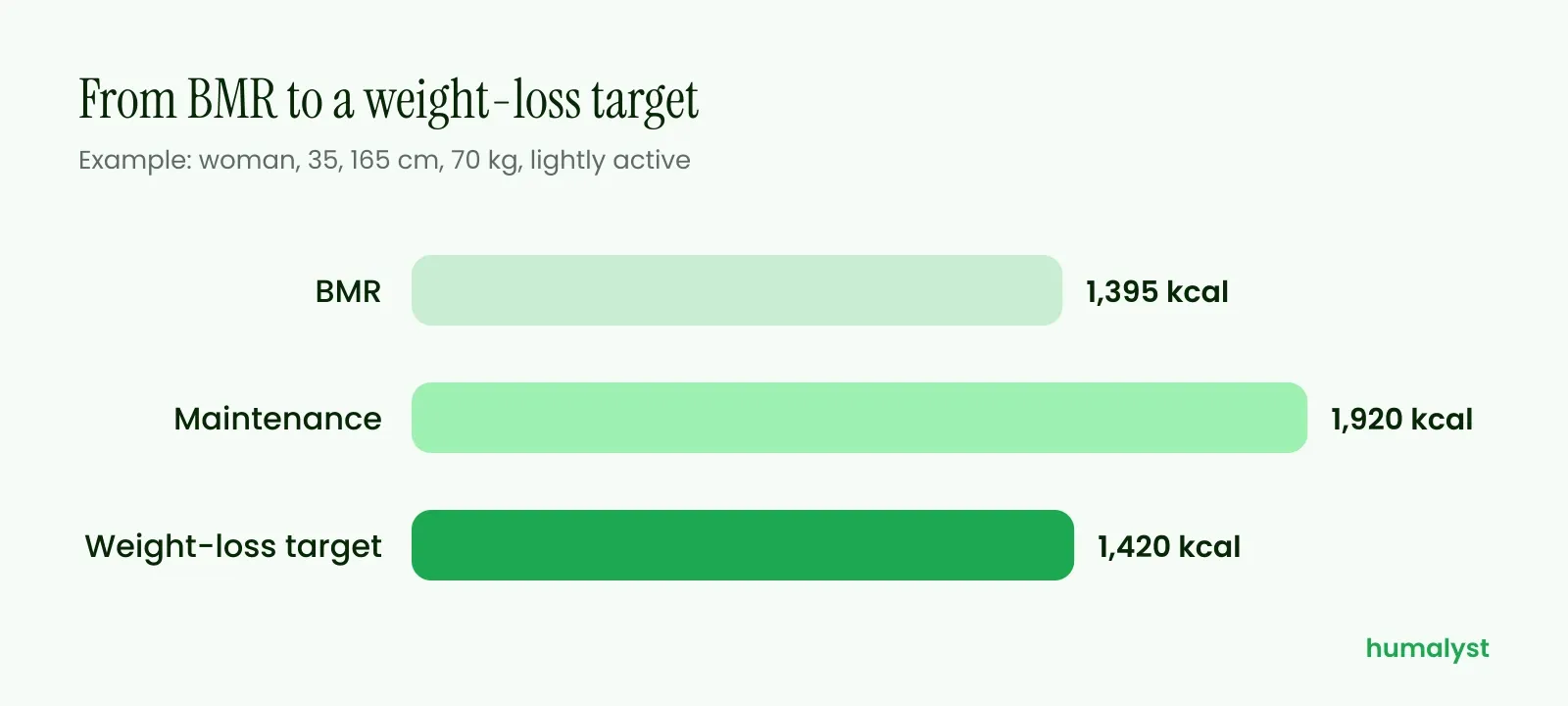
From BMR to maintenance to a sensible weight-loss target, using the first worked example.
Don’t go too low
It’s tempting to think “if 500 less is good, 1,000 less is better”. It usually isn’t.
Very low intakes tend to leave you hungry and irritable, make it hard to get enough protein, vitamins and minerals, and increase the chances you’ll lose muscle along with fat. They also make the rebound more likely. Harvard Health and many other experts advise not going below about 1,200 calories a day for women or 1,500 for men unless a doctor is supervising you.
If your maths lands below those numbers, that’s a sign to aim for a smaller deficit and add a bit more movement instead.
Why progress slows down (and what to do)
You might have heard “3,500 calories equals one pound of fat”. As a rough starting point it’s fine. But research led by Kevin Hall at the US National Institutes of Health showed that this rule overestimates long-term weight loss. As you get lighter, you burn a little less, so the same deficit produces slower results over time.
That’s not your metabolism “breaking”. It’s normal. Practically, it means:
- Re-calculate every 4–5 kg lost. Your maintenance number drops as you do.
- Judge progress over weeks, not days. Daily weight jumps around with water, salt and hormones. Look at the weekly average.
- Protect your muscle. Eat enough protein (see how much protein you need per day) and include some strength training.
The bit nobody likes to hear
The calculation is the easy part. The hard part is that most of us aren’t great at knowing how much we actually eat. Studies consistently find people underestimate their intake, sometimes by a lot.
That doesn’t mean you need to weigh every lettuce leaf forever. But for a few weeks, tracking honestly is eye-opening. Our guide on how to count calories accurately has the shortcuts that make it bearable.
The bottom line
Find your maintenance calories with Mifflin–St Jeor, eat about 500 less, aim to lose 0.5–1 kg a week, and recheck your numbers as you go. If you’d rather not do the maths, Humalyst calculates a recommended goal from your BMI details and activity level, and keeps it updated as your weight changes.
Quick answers
How many calories should I eat a day to lose weight?
Work out your maintenance calories, then eat about 500 calories less per day. For many women that lands somewhere around 1,400 to 1,800, and for many men around 1,900 to 2,400, but your own number depends on your size, age and activity.
How fast should I lose weight?
Health services like the NHS and CDC suggest about 0.5 to 1 kg (1 to 2 lb) a week. Faster loss is harder to sustain and more likely to cost you muscle.
Is it bad to eat too few calories?
Going very low can leave you tired, hungry and short on nutrients, and makes weight regain more likely. Many experts advise not going below about 1,200 calories a day for women or 1,500 for men without medical supervision.
Sources
This article is general information, not medical advice. If you have a health condition, are pregnant, or are making a big change to how you eat or drink, talk to a doctor or registered dietitian first.
Keep reading
 NutritionHow to Count Calories Accurately (Without Losing Your Mind)Most people underestimate what they eat. These nine practical habits make calorie counting more accurate, from food scales to cooking oil to eating out.
 NutritionHow Much Protein Do You Need Per Day?The 0.8 g/kg rule is a minimum, not a target. Here's how much protein you need per day by weight, age and goal, plus what that looks like on a plate.
 BMI & weightWhat Is a Healthy BMI? BMI Categories, ExplainedA healthy BMI for most adults is 18.5 to 24.9. Here's what each BMI category means, how to work yours out, and when the number needs more context.