Hydration
How Much Water Should I Drink a Day? (By Weight)
Forget the one-size 8 glasses rule. Here's how much water you actually need based on your weight, activity and climate, with simple maths you can do.
“Drink eight glasses of water a day” is one of those rules everyone’s heard and nobody can quite source. It’s not terrible advice, but it treats a 50 kg office worker and a 95 kg builder in the summer as if they had the same needs. They don’t.
Here’s a better way to work out how much water you need, based on your body and your day.
What the official guidelines say
Two of the most cited reference points come from Europe and the US. Both refer to total water, which means everything you drink plus the water in your food.
| Women | Men | |
|---|---|---|
| EFSA (Europe) | 2.0 litres a day | 2.5 litres a day |
| National Academies (US) | about 2.7 litres a day | about 3.7 litres a day |
The US figures look higher because they’re based on what healthy people actually consume, with no particular deficit in mind. EFSA’s are closer to a sensible minimum for moderate conditions.
Food usually covers around 20% of your water. Fruit, vegetables, soup, yoghurt and even bread all contribute. So in drinks alone, EFSA’s numbers translate to roughly 1.6 litres for women and 2 litres for men. That’s about six to eight glasses.
The by-weight method
Guidelines by sex are a fine starting point, but your weight matters more. A simple rule many clinicians use:
About 30–35 ml of water per kg of body weight, per day.
Some quick examples:
| Body weight | Daily water (30–35 ml/kg) |
|---|---|
| 55 kg (121 lb) | 1.65 – 1.9 litres |
| 70 kg (154 lb) | 2.1 – 2.45 litres |
| 85 kg (187 lb) | 2.55 – 3.0 litres |
| 100 kg (220 lb) | 3.0 – 3.5 litres |
That’s your base. Now adjust it for your actual day.
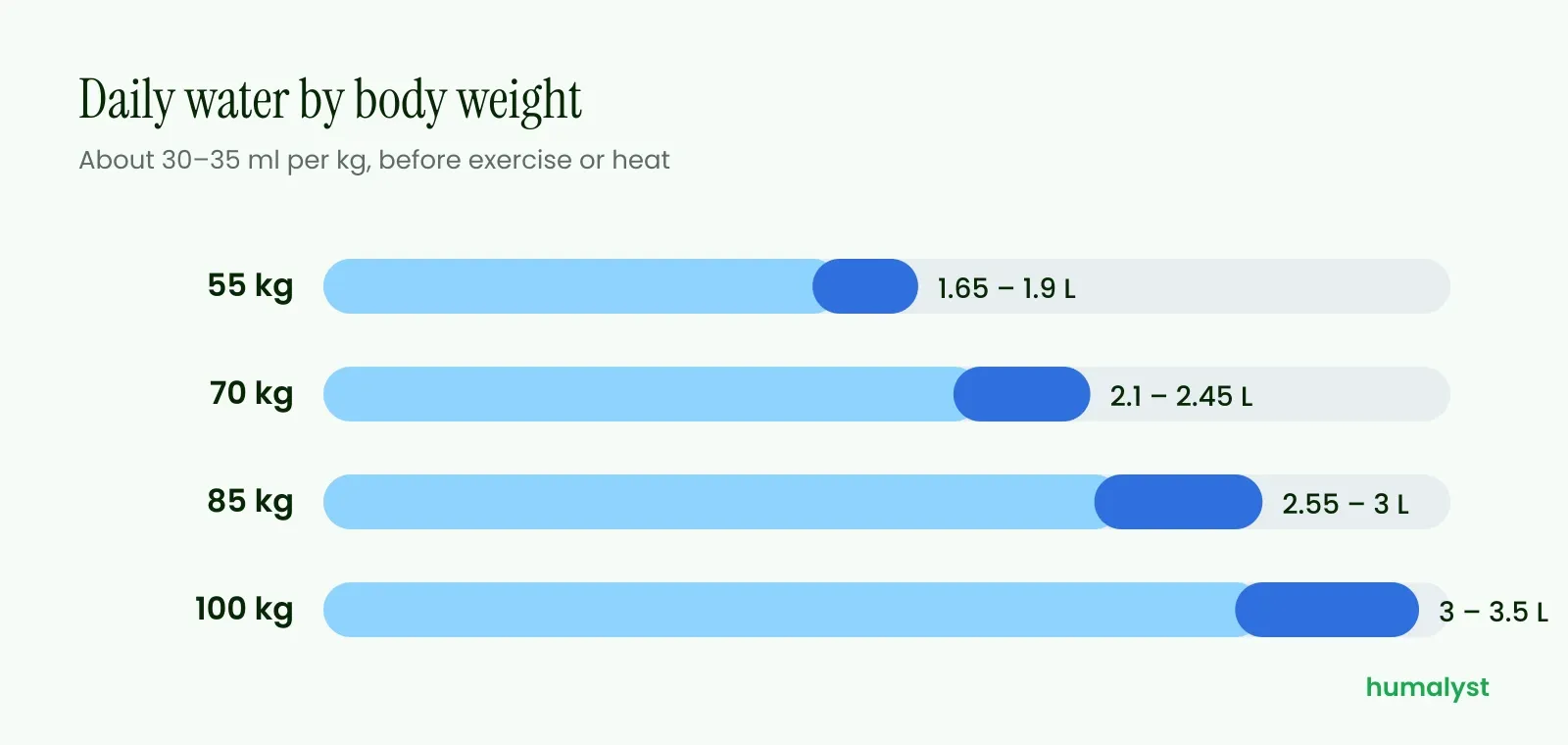
Daily water by body weight, at about 30–35 ml per kg, before adding extra for exercise or heat.
Things that change how much you need
Exercise. You lose water through sweat, and some people lose a lot. A good rule of thumb is to add roughly 250–500 ml for a moderate workout and more for long or hot sessions. If you weigh yourself before and after a session, every 1 kg lost is about a litre of fluid to replace.
Hot or humid weather. You’ll sweat more even sitting still. Drink a bit more and start earlier in the day rather than catching up at night.
Dry climates and air travel. Dry air quietly pulls moisture from your skin and breath.
Pregnancy and breastfeeding. EFSA suggests about 300 ml more per day during pregnancy and 600–700 ml more while breastfeeding.
Illness. Fever, vomiting or diarrhoea can dehydrate you quickly. Oral rehydration solutions are better than plain water here, because they replace salts as well as fluid.
Important: if you have kidney disease, heart failure or another condition where your doctor has set a fluid limit, follow their advice over any general rule, including this one.
A quick worked example
Let’s say you weigh 70 kg, you do a 45-minute workout most days, and it’s summer.
- Base: 70 × 33 ml ≈ 2.3 litres
- Workout: + 0.4 litres
- Warm weather: + 0.3 litres
That’s about 3 litres of total water. Take off roughly 20% for food and you’re aiming for around 2.4 litres from drinks, or about ten 250 ml glasses.
How to tell if you’re getting enough
You don’t need to measure every sip. Your body gives you two easy signals:
- Your urine colour. Pale straw yellow is the goal. Dark yellow or amber usually means drink more. (Completely clear all day can mean you’re overdoing it.)
- Thirst. For most healthy adults, thirst is a reliable cue. The exception is older adults, whose thirst signal often gets weaker with age.
If you’re regularly tired, headachy or lightheaded in the afternoon, mild dehydration could be part of it. We cover the early warning signs in Signs of dehydration you shouldn’t ignore.
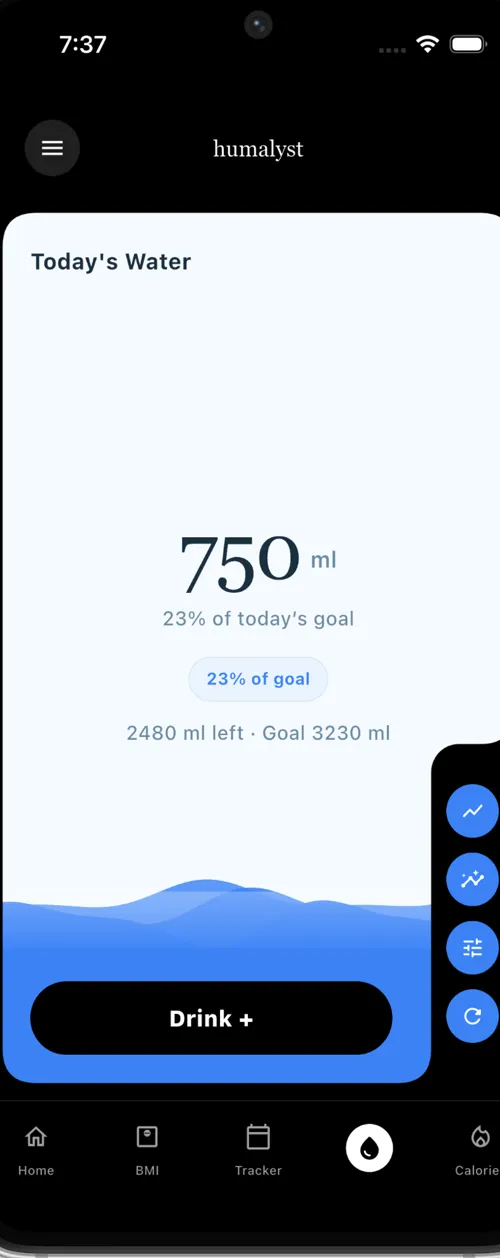
Humalyst’s water tracker: a personal goal, progress at a glance and a one-tap Drink button.
Make it easy on yourself
Knowing your number is the easy part. Actually drinking it is where most people fall down. A few things that genuinely help:
- Front-load your day. A big glass when you wake up and one with each meal gets you halfway there.
- Keep a bottle in sight. If it’s on your desk, you’ll drink it.
- Tie it to things you already do. Coffee break, glass of water. Bathroom break, refill. (More on that trick in how to build healthy habits that stick.)
- Use reminders that adapt. Humalyst works out a personal goal from your weight, activity and climate, then spaces reminders across your waking hours, backing off once you’re on track.
The bottom line
For most adults, somewhere between 2 and 3 litres of total water a day is right, and 30–35 ml per kg of body weight is a solid starting point. Adjust for exercise, heat and life stage, and check your urine colour. Honestly, that’s more useful than counting glasses.
Quick answers
How much water should I drink based on my weight?
A common starting point is about 30 to 35 ml of water per kilogram of body weight per day. For a 70 kg adult, that works out to roughly 2.1 to 2.5 litres, then you adjust for activity and heat.
Do tea, coffee and food count towards my water intake?
Yes. Tea, coffee, milk and water-rich foods like fruit, vegetables and soup all count. Food typically provides around 20 percent of the water we take in.
Can you drink too much water?
Yes, though it's rare in healthy people. Drinking very large amounts in a short time can dilute the sodium in your blood. People with kidney or heart conditions may also be told to limit fluids, so follow your doctor's advice.
Sources
This article is general information, not medical advice. If you have a health condition, are pregnant, or are making a big change to how you eat or drink, talk to a doctor or registered dietitian first.
Keep reading
 HydrationSigns of Dehydration You Shouldn't IgnoreFrom dark pee to afternoon headaches, here are the early signs of dehydration, the serious ones that need a doctor, and the quickest ways to rehydrate.
 Habits & moodHow to Build Healthy Habits That Actually StickForget the 21-day myth. Here's what research says about how long habits take to form, and six practical ways to make healthy habits stick for good.
 NutritionHow to Count Calories Accurately (Without Losing Your Mind)Most people underestimate what they eat. These nine practical habits make calorie counting more accurate, from food scales to cooking oil to eating out.